
Unitree B1
Unitree B1 is an industrial-grade quadruped developed for weather-exposed inspection and mobile technical work.
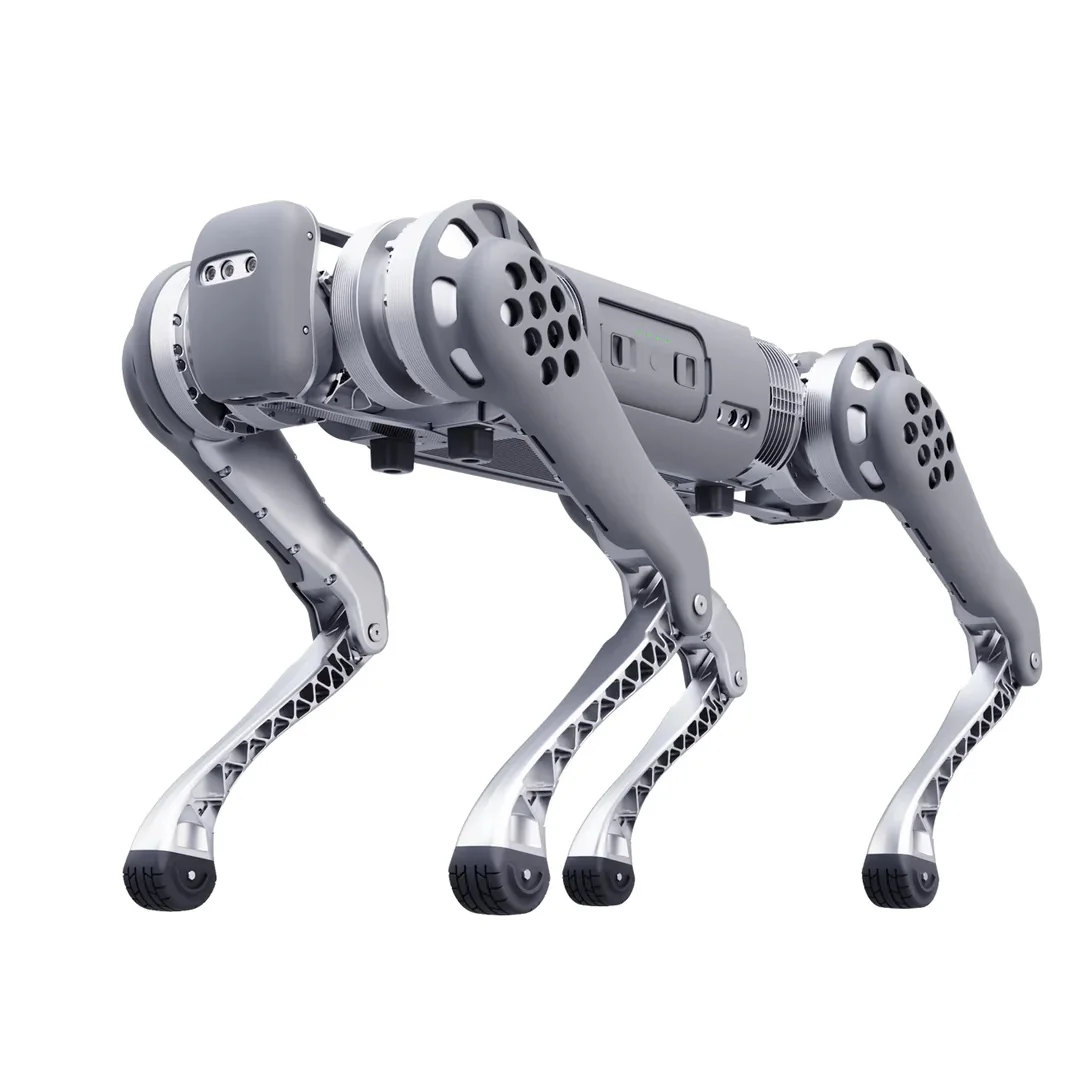
Model overview
Unitree B1 is an industrial-grade quadruped developed for weather-exposed inspection and mobile technical work. It belongs to an earlier generation of heavier Unitree robots, with an approximately 50 kg body and substantial space for sensors and other payload equipment.
Applications and practical role
B1 can be assessed for research on industrial patrols, field sensing, agricultural environments and supervised surveying. A practical deployment requires the appropriate cameras, LiDAR, computing and communications rather than treating the machine alone as an automated service.
Design and key capabilities
Its rugged construction carries an IP68 protection claim, with published continuous walking payload around 20 kg and a higher standing-load figure. The manufacturer positions it for complex surfaces and environmental sensing, but water protection must still be understood within the stated test and maintenance conditions.
AI, offline functions and connectivity
The robot has onboard motion control and sensors; this alone does not prove that a generative AI model runs locally or works without internet.
For this model, Unitree has not clearly documented which advanced AI functions, if any, work fully offline and which rely on external computing or network services.
Check the precise edition, available SDK, computing modules, app and internet requirements and any cloud or subscription terms. A demonstrated function may require additional software development.
Technical specifications
| Dimensions | 1126 × 467 × 636 mm |
|---|---|
| Weight | Approx. 50 kg |
| Continuous load | Approx. 20 kg |
| Standing load | Approx. 80 kg |
| Unloaded continuous walking | Approx. 2 hours |
| Protection | IP68 |
Technical values refer to the listed model or configuration; performance and equipment may vary by version and operating conditions.
What to check before choosing
The distinction between moving and stationary loads is particularly important. Check product generation, warranty, parts availability, software versions and sensor configuration, and compare B1 with newer B2-family alternatives before selecting it.